


لَا أُقْسِمُ بِيَوْمِ الْقِيَامَةِ وَلَا أُقْسِمُ بِالنَّفْسِ اللَّوَّامَةِ
“I do call to witness the Resurrection Day; and I do call to witness the self-reproaching Spirit.” (Qur'an 75:1–2)
“Let Not the Evil One Hinder You”: Qur’an 43:61–62 and the Danger of Missing the Age of Resurrection
Abstract
This paper is about hindrance, misrecognition, and eschatological blindness. Its center is not the identity of the Paraclete but the literary sequence of Qur’an 43:61–62: Jesus is a Sign of the Hour; doubt is rejected; the Straight Way is commanded; and immediately afterward comes the warning not to let Satan hinder.
The paper develops the thesis that a community can believe intensely in the Resurrection while still being vulnerable to missing an actual resurrection-process if it has defined fulfillment in advance as something that can occur only after ordinary history has ended. A strictly postponed model can therefore become a mechanism of non-recognition. The danger is not belief in final judgment; it is allowing belief in a future consummation to exclude the possibility of a present Age of Resurrection characterized by signs, announcement, awakening, moral disclosure, and conscious response.
An-Nabaʾ then becomes central because its Great News is disputed by living human beings. Al-Qadr is examined as a theological pattern of grace and opportunity before closure; al-Qāriʿah represents the terminal horizon of judgment. The paper concludes that the most sophisticated form of satanic hindrance would not necessarily be disbelief in God or the Hour, but a religious certainty rigid enough to make genuine signs unrecognizable.
Contents
- Why verse 62 changes the meaning of verse 61
- What “hindrance” means in an eschatological context
- How expectation can become an obstacle to recognition
- The two-horizon model: Age of Resurrection and final judgment
- An-Nabaʾ and the logic of living disputants
- Al-Qadr as the period of grace before closure
- Al-Qāriʿah as the terminal horizon
- How to distinguish discernment from accusation
- Conclusion
1. Why Verse 62 Changes the Meaning of Verse 61
Paper II begins where Paper I only touches briefly: with the warning. The transition from verse 61 to verse 62 is conceptually explosive. The reader is given an eschatological Sign and then immediately warned that recognition can be obstructed.
This means that eschatology is not merely about waiting for events. It is also about the conditions under which those events are recognized or rejected.
2. What “Hindrance” Means in an Eschatological Context
Hindrance is more subtle than simple disbelief. One can believe in God, scripture, prophecy, the Hour, and final judgment while still being hindered from recognizing a particular divine development. Religious commitment itself does not guarantee interpretive openness.
The Qur’anic warning becomes especially serious when linked with Satan’s vows in passages such as 7:16–17 and 15:39. Those verses portray deception as strategic and persistent. Yet they do not tell us automatically which disputed interpretation is correct. Their proper use is diagnostic, not polemical.
3. How Expectation Can Become an Obstacle to Recognition
The central psychological insight of Paper II is that expectation can both prepare and blind. A community awaiting a divine event develops a mental picture of what fulfillment should look like. If that picture becomes absolute, unexpected fulfillment can be rejected precisely because it does not match the inherited image.
A future-only model of Resurrection is vulnerable in this way. If every genuine resurrection event is defined in advance as post-historical, catastrophic, and physically unmistakable, then no present awakening, sign, announcement, or collective spiritual event can even qualify for investigation.
That is the mechanism of non-recognition proposed here. It is not necessary to abolish future judgment. The problem arises only when future judgment is allowed to monopolize the entire semantic field of al-Qiyāmah.
4. The Two-Horizon Model: Age of Resurrection and Final Judgment
This distinction is the structural heart of Paper II. It allows the argument to preserve Qur’anic final-judgment imagery while still making room for a living historical process preceding it.
Without this distinction, the paper collapses into a false choice between “spiritual Resurrection now” and “physical judgment later.” With the distinction, the model becomes sequential rather than contradictory.
5. An-Nabaʾ and the Logic of Living Disputants
The Great News is introduced through disagreement. Disputation presupposes cognition, hearing, interpretation, and response. This gives An-Nabaʾ a central role in the living-Resurrection thesis.
A corpse cannot dispute a message. A living person can. That observation does not by itself establish the entire eschatological framework, but it does make one point unavoidable: at least one phase of the Great News belongs to history populated by conscious respondents.
Paper II therefore treats An-Nabaʾ not as a subsidiary proof-text but as evidence that eschatology includes a communicative phase in which people can still misunderstand, resist, or accept.
6. Al-Qadr as the Period of Grace before Closure
The older paper made al-Qadr carry too much chronological weight. The revised version uses it more carefully. Classical interpretation concerns the Night of Decree/Power and the Qur’an’s revelation. Here the surah is used typologically rather than redefined.
Its imagery provides a pattern of divine descent, peace, angelic activity, and a bounded period ending at dawn. Within this paper’s synthesis, that pattern supports the concept of grace before closure: a merciful interval in which revelation is accessible and response remains possible.
7. Al-Qāriʿah as the Terminal Horizon
Al-Qāriʿah supplies the opposite pole: disruption, weighing, irreversible consequence. It is therefore useful as the symbolic horizon against which the Age of Resurrection gains urgency.
The logic is straightforward. Opportunity matters because it does not remain open forever. Judgment is just because warning, announcement, and response precede it. In this structure, al-Qadr represents openness and al-Qāriʿah represents closure—not as an explicit chronological scheme dictated by the two surahs, but as a theological synthesis.
8. How to Distinguish Discernment from Accusation
The older Satan-focused paper sometimes blurred warning and condemnation. This revision draws a firm line. Qur’an 43:62 authorizes vigilance against deception; it does not authorize casual declarations that entire religious populations are satanically controlled.
The correct use of the verse is to establish criteria for discernment. A claimed sign should be examined for documentary evidence, scriptural correspondence, moral coherence, experiential substance, and resistance to alternative explanations.
The warning is most powerful when applied symmetrically. Traditional believers can be blinded by inherited expectation. Reformers can be blinded by novelty. Devotees can be blinded by loyalty. Skeptics can be blinded by prior dismissal. No group is exempt.
9. Conclusion: Satanic Hindrance as Failure of Recognition
Paper II is intentionally not a Paraclete-identity paper. Its concern is the possibility of missing fulfillment even while professing belief in it.
Qur’an 43:61–62 places Sign and hindrance beside one another. That structure creates an interpretive responsibility: believers must not only await the Hour but examine the assumptions through which they expect to recognize it.
The two-horizon model offers a coherent solution. A living Age of Resurrection can precede final judgment, giving humanity signs, announcement, awakening, and opportunity. The final horizon can remain intact without erasing the present phase.
Within this framework, satanic hindrance is most dangerous when it becomes indistinguishable from certainty. The warning of verse 62 is therefore not merely about obvious unbelief. It is about the possibility that religious expectation itself can become the screen through which a divine sign disappears.
References
- Qur’an 43:61–62; 7:16–17; 15:39; 38:82; 78:1–5; Surah 97; Surah 101.
- Adishakti.org Al-Qiyāmah and An-Nabaʾ research materials.
- Comparative eschatological materials concerning the Living Resurrection and final judgment.
Compilation, Proclamation, and Exegesis of Surahs Upholding Allah’s (SWT) Command to His Ummah — to Witness and Participate in the Resurrection.
Al-Qiyamah: A Profound Declaration of Al-QiyamahAl-Qiyamah (75:1-2): Oaths of Resurrection
Al-Qiyamah (75:3-4): Reassembling Bones and Fingertips
Al-Qiyamah (75:5-6): Man's Denial of Resurrection
Al-Qiyamah (75:7–10): Sun and Moon 'Joined' At Solar Eclipse
Al-Qiyamah (75:7–10): Solar Eclipse Salat al-Kusuf
Al-Qiyamah (75:11–13): No Refuge, Only Reckoning
Al-Qiyamah (75:14–15): Man: His Own Witness and Judge
Al-Qiyamah (75:16–19): The Usurpation of Allah's Explanation
Al-Qiyamah (75:20–21): Love of The Fleeting World
Al-Qiyamah (75:22–25): Ruh’s Face Brings Either Glory Or Gloom
Al-Qiyamah (75:26–30): Death and Soul's Departure Home
Al-Qiyamah (75:31–35): The Rejection and Arrogance of the Kuffar
Al-Qiyamah (75:36–40): Is Resurrection Beyond Allah, Your Creator?
Al-Qiyamah (75:1-2 and 78:1–5): An Naba and Oaths of Resurrection
Al-Qiyamah (75:1-2 and 78:1–5): The Great News and Resurrection Rebirth
Al-Baqarah (2:138): Baptism of Allah You Were Unaware Of
Al-Baqarah (2:174): Allah Will Not Address Muslims
Al-A'raf (7:16) – Iblis: I Will Lie In Wait and Overpower Them
Al-A'raf (7:146): Allah: I Will Turn Them Away From My Signs
Al-A'raf (7:146): Allah: So Even Though They See All The Signs
Al-Hijr (15:39) – Iblis: I Will Wake (Evil) Fair and Mislead Them
An-Nahl (16:2) – Allah (SWT) Sent Down Angels With His Ruh
Al-Isra (17:85): Muslims Given Little of Allah's (SWT) Ruh
Al-Isra (17:104): Children of Israel Gathered Again (in 1948)
Al-Isra (17:104): Shaykh Palazzi: Children of Israel
Al-Hajj (22:8) – Kitab Al-Munir You Were Unaware Of
Al-Rum (30:56) – The Day of Qiyamah You Were Unaware Of
Fatir (35:9) – Winds of Qiyamah You Were Unaware Of
Yassin (36:63-68) – This Is The Hell You Were Warned Of.
Sad (38:79) – Iblis Allowed to Mislead Muslims And He Did
Fussilat (41:20–21) – Your Hands Will Testify of Qiyamah
Fussilat (41:53) – We Will Show Our Signs Within Your Soul
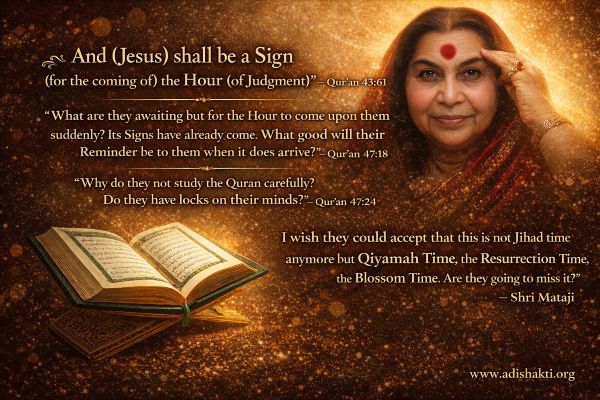
Az-Zukhruf (43:61): Jesus, Sign of Hour You Were Unaware
Az-Zukhruf (43:62): Satan's Deception of the Muslim Ummah
Az-Jathiya (45:7-14) – Those Who Deny Allah's Revelations
Qaf (50:20–21) – Hidden Imam Mahdi You Were Unaware
Qaf (50:41) – Listen To The Caller Emerging From Within
Qaf (50:42) – Day They Will Hear of Mighty Blast Witnessed
Qaf (50:45) – By the Caller, My Warning Is Delivered
Al Dhariyat (51:20-22) – Our Signs on Earth and Within
Al-Hadid (57:25) – Allah's (SWT) Iron Has Been Delivered
Al-Mujadilah (58:21) – My Messengers Must Prevail
Al-Saff (61:8–9) – Revelation of Light You Were Unaware
Al-Muddaththir (74:1–2) – My Cloaked One: Deliver Warning
Al-Mursalat (77:1–10): Angels Sent You Were Unaware Of
An-Naba (78:1–5): Concerning What Are They Disputing?
Al-Infitar (82:17–18) – What Will Explain To You? What Will?
Al-Mutaffifin (83:1–6) – Dealers in Fraud You Were Unaware
Al-Tariq (86:1–3) – The Night Visitant You Were Unaware
Al-Qadr (97:1–5) – Blessed Night of Power and Fate Before:
Al-Qariah (101:1–11) – Terrifying Day of Noise and Clamour
Search Adishakti.org
💬 Interactive Chat
Explore the scriptural arguments, sources, and theological distinctions developed in this paper.
Open chat →